“It is woman who is to come in at this emergency and meet the demand, woman, whom experience and testing has shown the best guardian and teacher of childhood.”
Catherine Beecher, excerpt from ‘The Duty of American Women to their Country’, 1845
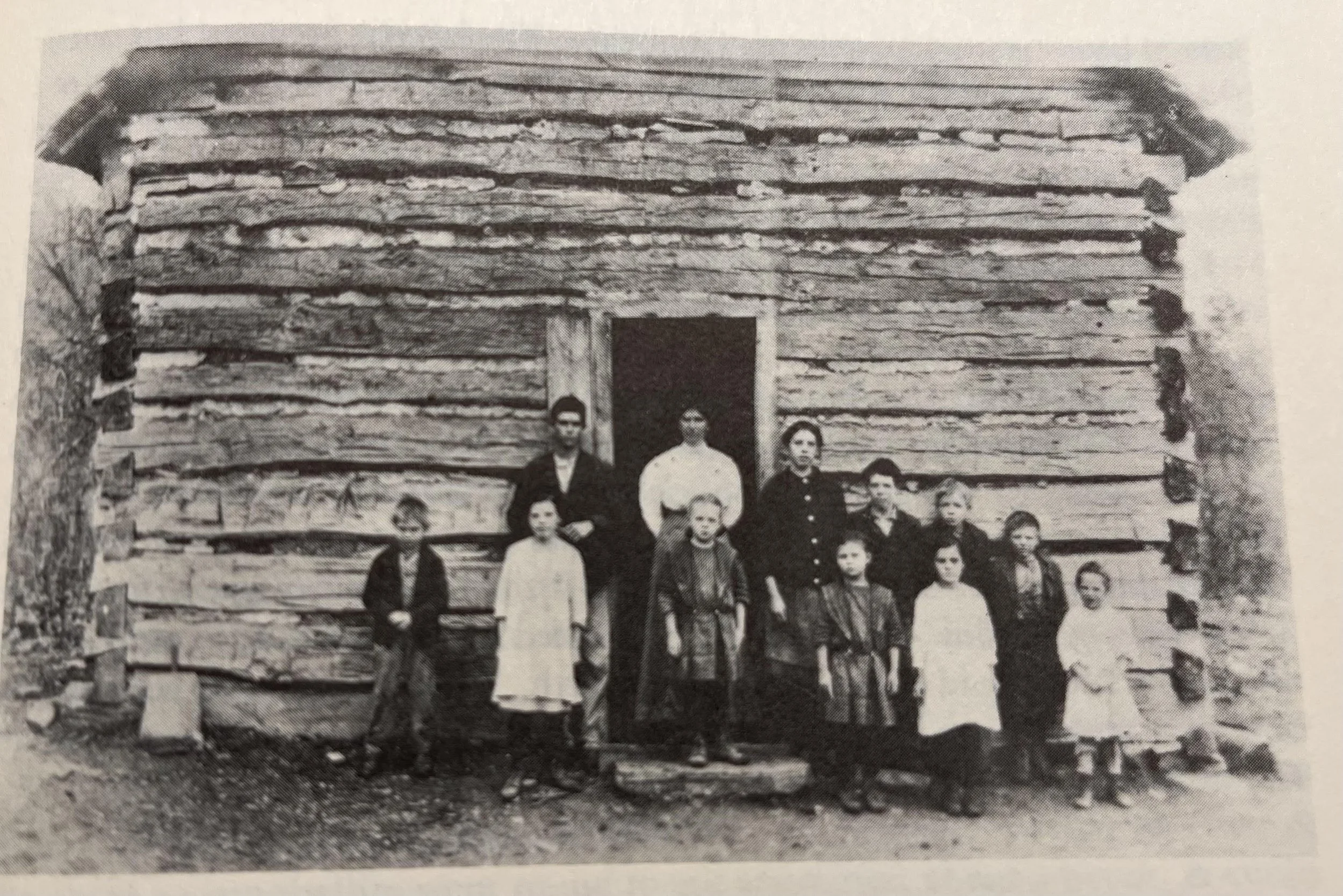
A one room, log school house in Barry County, Missouri
Though it seems an obvious fit now, women weren’t always the first choice as school master. In fact, until the beginning of the Civil War in the 1860’s, most teaching positions were held by men. Furthermore, despite all-girl schools in the eastern portion of the United States, most education was centrally focused on boys only. Thus, a male-dominated teaching field made sense.
However, as the Civil War ended and westward expansion became the apple of the nation’s eye, the country suffered a shortage of male teachers, as tradition dictated. Opinions on the western frontier were ever changing, and as families ventured farther and farther from accustomed culture and its benefits, the job of educating children was falling to the wives and mothers who’d once been deemed as “unnecessary to educate”.
This opened the playing field not only for female students, but as the enticing proposition of better paying jobs and greater opportunities out west in the gold and silver fields took the male teachers, the female students were left to take up the task of teaching school. As new communities formed overnight in a vast and unsettled territory, pioneer women were concerned with the demands of homesteading, which left very little time for schooling children- if they had any education to do so.
Communities consisted of little to no buildings, and what few were there, weren’t much more than primitive at the start. So, as the demand for education grew, it fell to families to recruit and house teachers. It wasn’t uncommon for educators to be hired from eastern states, brought out west, then boarded in the home of one of the school families.
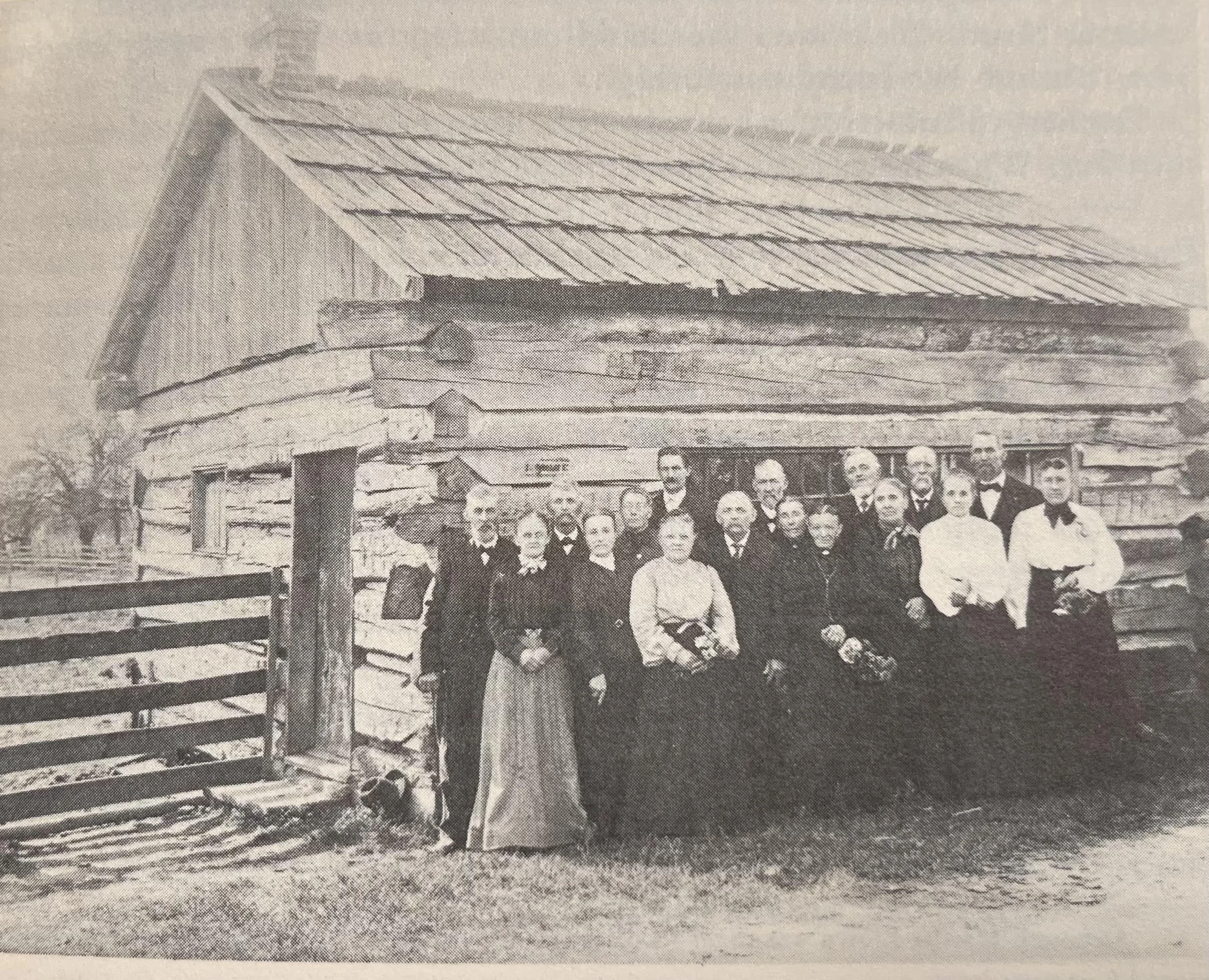
Log schoolhouse in Allen County, Indiana. The building was established in 1840. Shown here are students of this little school at a reunion in 1900. Photo credit ‘Women Teachers on the Frontier’ by Polly Kaufman.
In Perspective- At the end of the Civil War, teachers were a scarcity. As young women completed school through the 8th grade, they were in high demand to become schoolmarms in the expanding west. Imagine being just a tender 14 or 15 years old, graduating, then taking a job as a teacher to children your own age and size. We’ve all seen Little House on the Prairie- when Laura takes her first teaching job and has difficulties with the older boys in the class. It would have been hard to take the teacher seriously as a young man in the school room. However, most boys quit school before the 8th grade to work at home on the family homestead where they were needed for the hard work of sustaining life.
Public, tax paid schools were still in the future at the end of the 19th century, so like modern homeschooling, all teacher’s wages, school buildings, and supplies were provided by the families. In a homesteading lifestyle, families were often cash-poor for the majority of the year.
Most young teachers were well chaperoned and lived with a host family for the duration of the school year. Those young educators who were lucky enough to land a job with a schoolhouse and “teacherage” were often greeted with the full-time task of chopping wood and hauling water. Their housing was usually a room in the back of the schoolhouse with little to no heat. It was the responsibility of the educator to start the fire every morning at five, maintain the building, and provide the lessons.
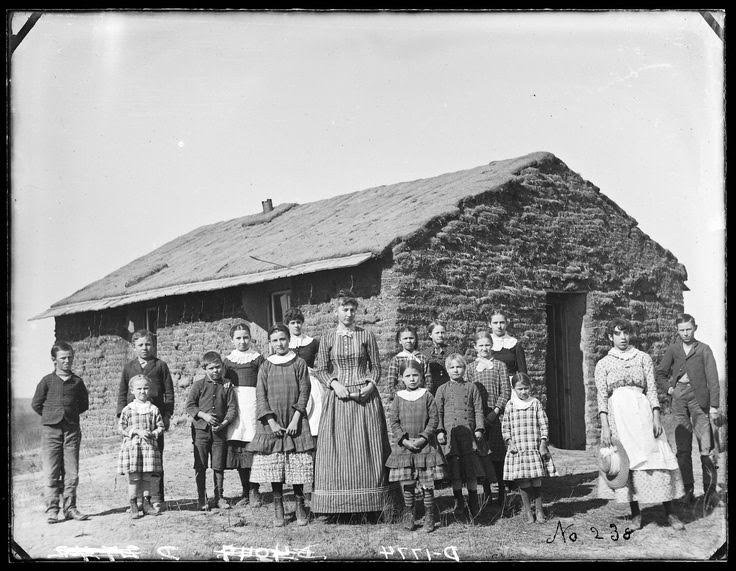
A sod schoolhouse in Kansas. Note the young age of the teacher holding the bell. Photo courtesy of the Library of Congress.
In Perspective- Common Terms of 19th Century Schooling-
Blab School- a school where many of the lessons were read and recited out loud as a class.
By Subscription- a means of paying for school- the family paid a subscription as tuition
Common School- open to the public
Normal School- secondary schools, like junior college in today’s age, where students were trained to be teachers.
Horn or Crib Book- used like a clipboard. The lesson was printed on a hard substance when desks were not available.
Slate- a small, hand-held chalkboard
Primer- 1st standardized schoolbook
Cyphering- basic math skills
The school term wasn’t the same as it is now. In fact, life didn’t revolve around the start, and eventually, the completion of the school year. Instead, school was fitted in around the farm and ranching schedule. Many brave teachers spent three months teaching in the fall after harvest, then school let out for the harshest of the winter months. In the spring, school started back up before the start of field preparations, then after planting was finished. They often went through portions of the summer months when travel was easier on the students.
A woman, pioneer teacher was paid $25 a month for her work. For a single woman, those were good wages. Except, the work wasn’t year-round. For most, that meant living very meagerly in the off months with the wages they did make.
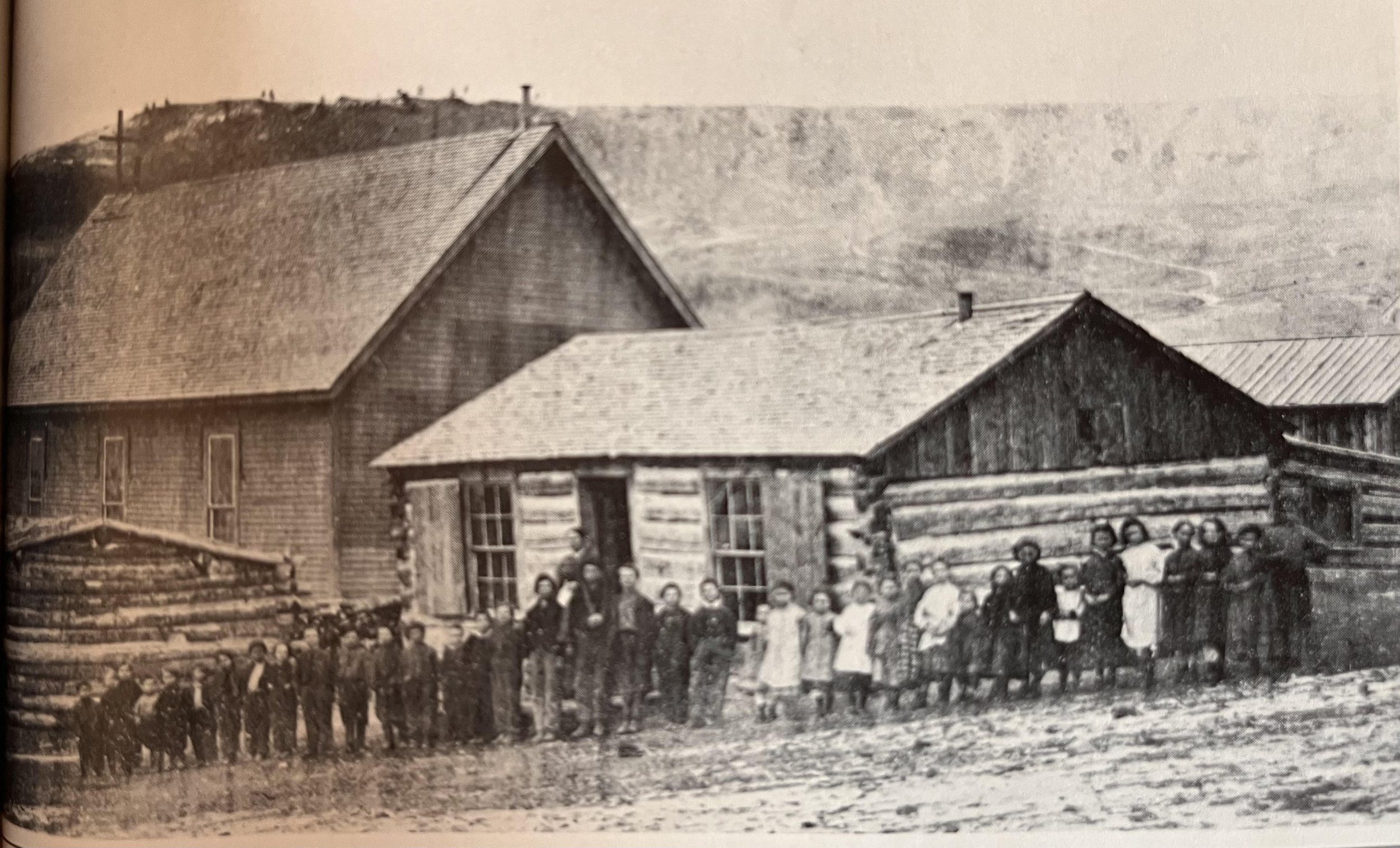
One-room schoolhouse in Virginia City, MT. The students pictured were taught in the small log building in the lower left of the photograph. Photo from Library of Congress.
In Perspective- Young women at the end of the 19th Century in the teaching profession were expected to follow some strict rules.
Marriage- Legally, female teachers had to remain single. Once married, all contracts were immediately void.
No dating or male company was allowed. Women teachers couldn’t be seen riding in carriages with men who were not immediate family.
Teachers had to be within the confines of their homes- either where they were boarding or in the teacherage- between 8 pm and 6 am. They had to have wood hauled and chores completed by that time.
There was no loitering in ice cream parlors, or establishments that served alcohol.
To leave town required permission from the school board.
No make-up of any kind, and no curling of the hair or dying of hair color.
For many women teachers, coming west was very difficult. For those accustomed to the fine schoolhouses in the east, the transition to working without books and materials was difficult. The only literature most families had was either the Bible, or the Sears and Roebuck Catalogue, which students brought to school to read in place of Primers. Ads were torn from the catalogue to decorate the humble walls of the schoolhouse.
“Another day of trials. The wind would not permit us to keep the door shut at school, and I was obliged to station a lad there to hold it. I never felt wind push so as it does here. I have often experienced today’s troubles.” - Excerpt from Arozina Perkin’s diary. Fairfield, Iowa 1851
The dangers of being a lady alone on the prairie was great- the travels west were less than comfortable.
“For the entire 14 miles, at least one wheel never touched the ground because of the rocks of all sizes and kinds.” - The 1880 Diary of Angeline Mitchell
Many lady teachers arrived at western outposts and found the conditions less than satisfactory- for instance, a schoolhouse constructed of stacked sagebrush. For some of the teachers, they stayed the contract of two year’s teaching and then returned home to the east. Many stayed and married out of the profession. This decision wasn’t always looked upon happily by fellow educators.
“It is not impossible that more than one of us may think it is best to make permanent homes for ourselves in the west. But I hope that no more will think it best until they have been here at least one year.” - Mary Washburn, teacher
Despite the disapproved nature of considering marriage, two-thirds of the teachers that ventured west did make the frontier their permanent home. One-third retreated back to the sanctuary of eastern schools, and most of that remaining third, married and had families of their own, though prejudice in their early years of teaching found such a notion unfathomable.
One thing is for certain, without the bravery of these heroic women and the efforts they put into the lives of their students, the west would not have been able to rise to what it is today. Whether young or old, veteran or celebrating the recently earned teaching certificate, these women left careers in long standing establishments to bring culture and skills to those settling the frontier. It was not an easy choice, but one that impacted the school system of today. These were brave women, bringing with them the only weapon they had- knowledge.
Coming Up Next-
Granada- Legendary
December 15, 2026
Ready for a teaser of what I’m currently working on? Chapters of Granada-Legendary, or G3 as I call it, will be released by email through website to all subscribed readers!